
In today’s industrial manufacturing sector, energy management has evolved from a mere “cost consideration” into a “survival imperative” for enterprises. As global supply chains tighten requirements for green, low-carbon operations, the operating efficiency of air compressors—often dubbed the “power guzzlers” of the factory—directly impacts corporate profit margins.
When procuring compressed air systems, companies often face a classic dilemma: should they choose fixed-speed compressors with lower initial investment costs, or opt for technologically advanced variable-speed drive (VSD) compressors?
There is a common claim that VSD technology saves 30% on energy; is this merely a marketing gimmick, or does it translate into tangible financial savings? This article provides an in-depth analysis of the core differences between the two and helps you calculate the actual economic benefits.
Fixed-Speed vs. VSD: A Simplified Comparison of Core Operating Principles
To understand the origin of the “30% energy saving” figure, one must first grasp the differences in their operating mechanisms:
Fixed-Speed Compressors
Think of these as having a switch with only two settings: “Off” (or idle) and “Max.” They operate at a constant speed; when factory air demand drops, they maintain pressure by adjusting the intake valve (switching between load and unload modes). Even in the “unloaded” state, the motor continues to spin idly, wasting significant amounts of electricity.
VSD Compressors
These possess a “smart brain.” Using a variable-speed drive, they monitor downstream air pressure fluctuations in real-time and precisely adjust the motor’s rotational speed. Speed increases when demand is high and slows down when demand is low, truly achieving “supply-on-demand” and a perfect match between air production and consumption.
How Are Electricity Costs Reduced by 30%?
Data doesn’t lie. In most real-world production scenarios, factory air demand is not static; it typically fluctuates between peak and off-peak periods. VSD compressors achieve energy savings of 30%—or even more—by eliminating the following three types of “hidden waste”:
1. Eliminating Energy Waste During Unloaded Idling
When a fixed-speed unit is idling in the unloaded state, it still consumes approximately 30% to 40% of its rated power. By adjusting rotational speed, VSD units virtually eliminate the “idling” phase—where the machine runs but performs no useful work.
2. Precise pressure control to prevent over-compression
Fixed-speed units must constantly cycle between loading and unloading within a set pressure band (e.g., 0.6–0.7 MPa). However, every 1 bar (0.1 MPa) increase in system pressure adds approximately 7% to energy consumption. VSD units maintain pressure within an extremely narrow range (±0.01 MPa), avoiding unnecessary “high-pressure air generation.”
3. Eliminating startup current spikes
The inrush current of a fixed-speed unit during startup can be several times its rated current; this not only stresses the power grid but also increases the risk of penalties for high peak power usage. VSD units utilize soft-start technology, ensuring a smooth rise in current with zero impact.
Smart Manufacturing Transformation: Shaanxi Kaishan’s Low-Carbon Solution
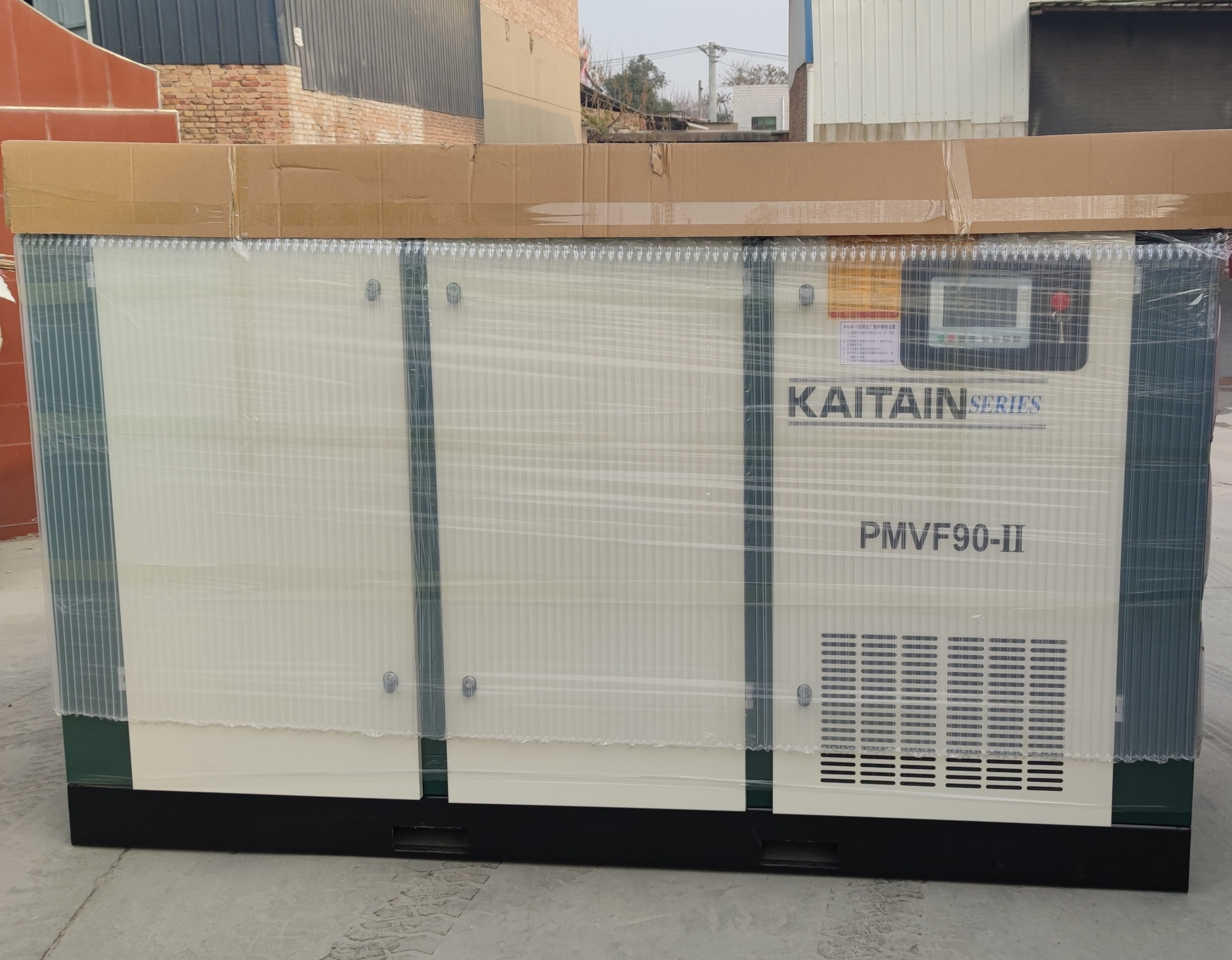
Amid the global industrial drive for maximum energy efficiency, Shaanxi Kaishan remains at the forefront of pneumatic technology innovation. Addressing the pain points of fluctuating air demand and high electricity costs faced by enterprises, Shaanxi Kaishan has developed a high-efficiency VSD screw air compressor that is becoming a powerful energy-saving tool for sectors such as discrete manufacturing, chemicals, and textiles.
Shaanxi Kaishan’s VSD screw air compressors not only inherit the energy-saving DNA of VSD technology but also feature high-standard, localized optimizations of core components:
- ✔
Integrated Permanent Magnet VSD Technology: Employs a high-efficiency permanent magnet motor that maintains superior efficiency even at low speeds, offering greater energy savings than standard VSD systems.
- ✔
Customized Air-End Design: Kaishan’s proprietary screw air-end utilizes an optimized rotor profile, ensuring high volumetric efficiency and a long service life right from the source.
- ✔
Intelligent Monitoring System: Capable of detecting pressure fluctuations at the millibar level with sub-second response times, ensuring that every kilowatt-hour of electricity is converted into genuine productivity.
Feedback from a heavy industry client indicates that after replacing their existing fixed-speed units with Shanxi Kaishan variable-frequency screw air compressors, overall energy consumption dropped by 32.5%. Savings on electricity costs alone are projected to recoup the entire investment in the upgrade within 18 months.
How do you choose the right system?
If your factory operates at full load 24 hours a day with extremely stable air demand, fixed-speed air compressors remain a viable choice due to their high full-load efficiency and low initial investment.
However, if your production lines involve multiple shifts, frequent changes in operating conditions, or significant fluctuations in air demand across process stages, a variable-frequency air compressor is undoubtedly a more forward-looking, long-term investment. Against the backdrop of carbon peak and carbon neutrality goals, choosing a Shaanxi Kaishan variable-frequency screw air compressor means more than just acquiring high-efficiency equipment; it secures a long-term, low-carbon competitive advantage for your enterprise.
About Shaanxi Kaishan:
As an industry expert specializing in air power systems, Shanxi Kaishan is dedicated to providing efficient, eco-friendly, and intelligent compressed air solutions to global customers. We invite you to contact our engineers for a customized energy efficiency assessment and equipment upgrade plan tailored to your specific needs.
Post time: Jul-07-2026


