
In the world of rock excavation, mining, and construction, efficiency is everything. Among the various methods available, Down-the-Hole (DTH) drilling stands out as one of the most effective techniques for penetrating hard rock formations.
But what exactly is DTH drilling, and why is it preferred over other methods? This guide breaks down the essentials.
What is DTH Drilling?
DTH drilling is a percussion drilling method. The name “Down-the-Hole” comes from the fact that the hammer mechanism—the part that actually strikes the rock—is located directly behind the drill bit at the bottom of the hole.
Unlike Top Hammer drilling, where the energy is struck at the top of the drill string, DTH energy is applied right where it’s needed: against the rock face.
How It Works: The Mechanics
The DTH process involves three primary movements:
-
Percussion: A pneumatic hammer is driven by compressed air to strike the back of the drill bit.
-
Rotation: A hydraulic motor on the rig rotates the drill string to ensure the bit strikes a fresh surface with every blow.
-
Feed Pressure: The rig applies downward pressure to keep the bit in constant contact with the rock.
As the bit crushes the rock into chips, compressed air is blown down the hollow drill pipes and out through the bit, flushing the cuttings up to the surface.
Why Choose DTH Drilling?
DTH technology offers several distinct advantages, especially for deep-hole projects:
-
Consistent Power: Because the hammer stays at the bottom of the hole, there is virtually no energy loss through the drill rods, regardless of how deep you drill.
-
Straightness: DTH rigs are famous for drilling exceptionally straight holes, which is critical for accurate blasting and foundation work.
-
Hard Rock Capability: It excels in hard, abrasive rock conditions where other methods might struggle or wear out equipment too quickly.
Separated vs. Integrated DTH Rigs
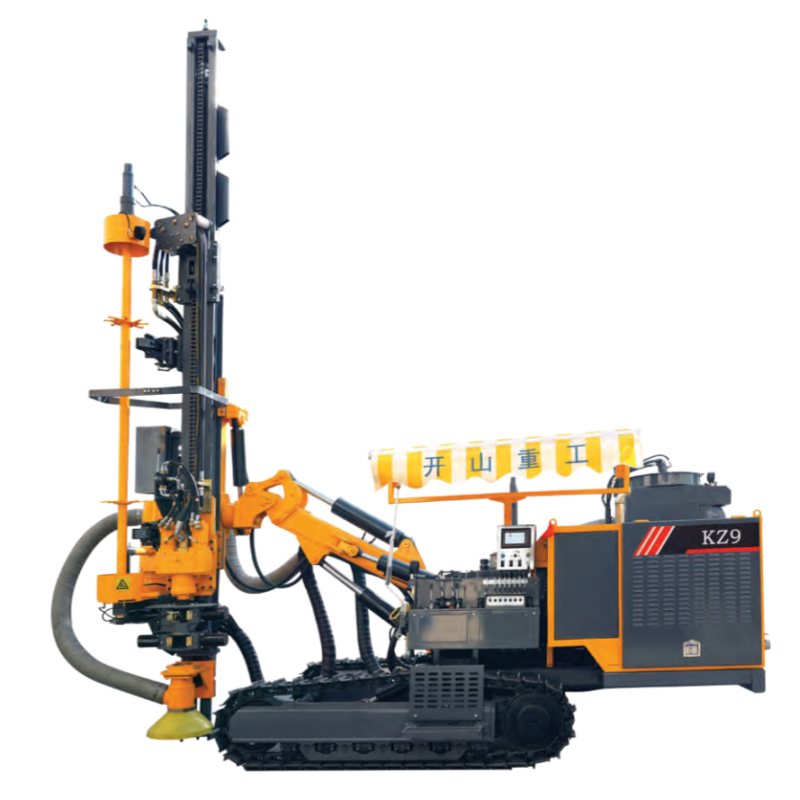
When choosing a rig, you will often encounter two types: Integrated and Separated (like the KZ9 Surface DTH Drilling Rig).
-
Integrated Rigs: Have the air compressor built into the machine.
-
Separated Rigs: Require an external air compressor. These are often preferred for their lower maintenance costs, greater flexibility in rough terrain, and lower initial investment.
Applications of DTH Technology
DTH drilling is the “workhorse” of several industries:
-
Open-Pit Mining: For creating precise blast holes.
-
Quarrying: Extracting limestone, granite, and marble.
-
Civil Engineering: Foundation piling and anchoring.
-
Water Well Drilling: Reaching deep aquifers through solid rock.
Understanding DTH technology is the first step in optimizing your site’s productivity. By delivering energy directly to the rock, DTH rigs provide a level of precision and power that is hard to match.
For those looking for a reliable, cost-effective entry into high-performance drilling, a separated crawler rig like the KZ9 offers the perfect balance of durability and operational flexibility.
 ‘’
‘’
Post time: Apr-30-2026


